
Talbot County Orphans' Court Records
Maryland uses the name Orphans' Court for the local probate court. In Talbot County, probate records are tied to the Orphans' Court and the Register of Wills, not to the District Court and not to ordinary county Public Information Act routing. Estate files may include wills admitted to probate, petitions, letters of administration, personal representative appointments, interested-person lists, inventories, accounts, claims, notices, and orders. The Register of Wills is the record office for estate filings, while the Orphans' Court acts on probate matters within its authority.
The Register of Wills for Talbot County is the practical contact point for estate record searches, probate forms, and file-copy questions. The Talbot County Orphans' Court is the court venue for probate hearings and orders. A person looking for a divorce decree, marriage certificate, or criminal case should use the Circuit Court clerk instead, because those records do not sit in the estate file.
Orphans' Court for Talbot County
Connected with the Register of Wills and estate office
Easton, MD
Register of Wills for Talbot County
Estate filings, searches, claims, forms, and probate copies
Talbot County Probate Terms
Probate records use terms that can be hard to read without context. These definitions keep the main estate roles clear before searching the online estate portal or requesting copies from the Register of Wills.
- Testator
- A person who made a will.
- Executor
- A person named in a will to carry out estate administration, often called a personal representative in Maryland practice.
- Intestate
- Dying without a valid will, which can change who receives notice and how property passes.
- Guardianship
- A court-supervised role for a minor or protected person when probate-related authority is needed.
- Conservatorship
- A property-management concept used in some states; Maryland probate users should verify the local term and record type with the Register of Wills.
Search Talbot County Estate Records
The main online estate channel is the Maryland Register of Wills search landing page, which links to Estate Search and Claim Search. The estate portal lets users search by estate number, name, county, estate status, estate type, filing date, and party type. During research, the Estate Search page displayed a latest-data timestamp of 6/26/2026 4:00:00 PM, which means users should treat refresh timing as part of the search result.
The Register of Wills Estate Search form is shown here because it is the official portal for Talbot County probate record lookup.
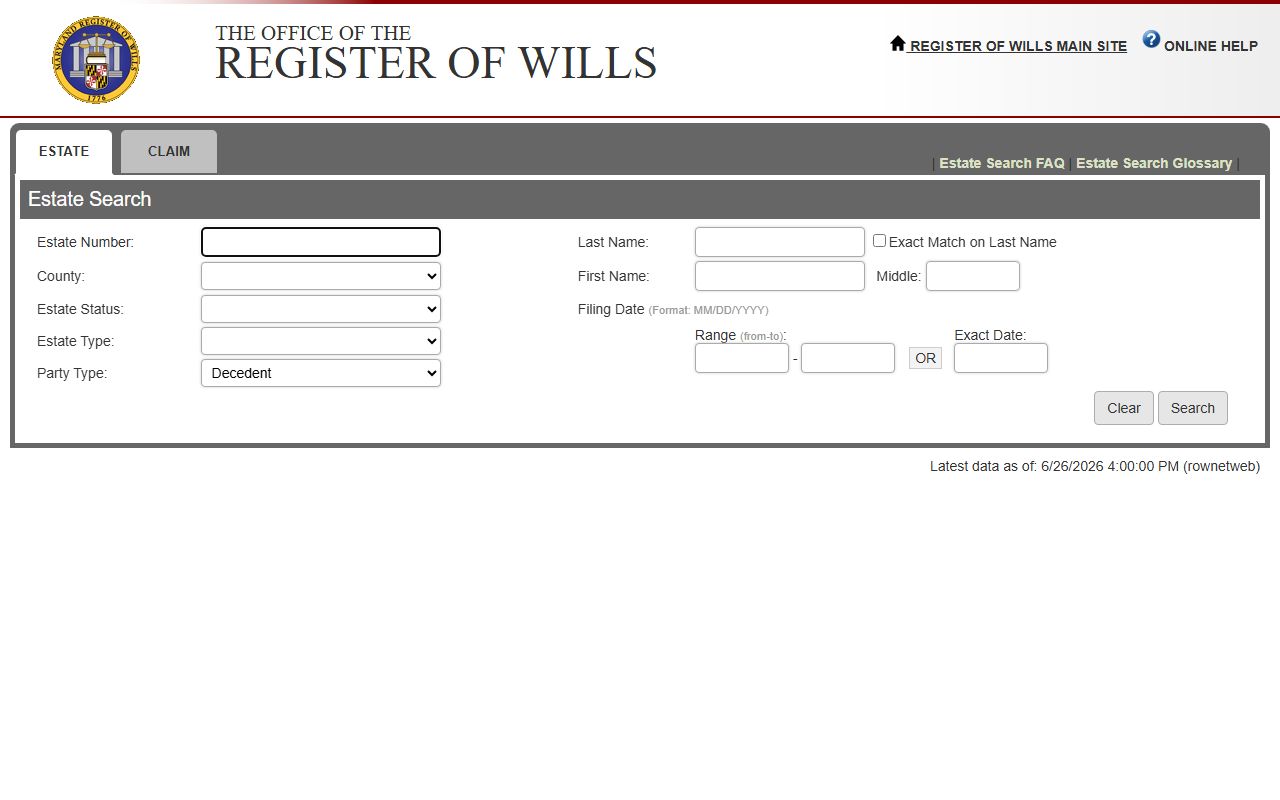
The form's county field should be set to Talbot when a statewide name search returns too many matches, and the party-type field helps separate a decedent search from a personal representative search.
| Field Label | Type | Required | Options or Format Notes |
|---|---|---|---|
| Estate Number | Text | Optional | Use the exact estate number when known. |
| Last Name | Text | Optional | Exact Match on Last Name checkbox is available. |
| County | Dropdown | Optional | Select Talbot to narrow statewide results. |
| First Name and Middle | Text | Optional | Each field accepts a name value. |
| Estate Status | Dropdown | Optional | Includes open, closed, pending, and archive-style status codes. |
| Estate Type | Dropdown | Optional | Includes small-estate and regular-estate type codes. |
| Filing Date Range | Date | Optional | Use MM/DD/YYYY where accepted. |
| Party Type | Dropdown | Optional | Decedent or Personal Representative. |
Find Talbot County Estate Claims
Claims against estates are searched through a separate Register of Wills portal. A creditor, family member, personal representative, or researcher may need both the estate record and claim record because a claim can have its own type, status, date, and filer information. The claim portal supports filed-by and decedent searches, name fields, estate number, county, claim type, and claim status.
The Register of Wills Claim Search form gives a distinct route for Talbot County probate claims.
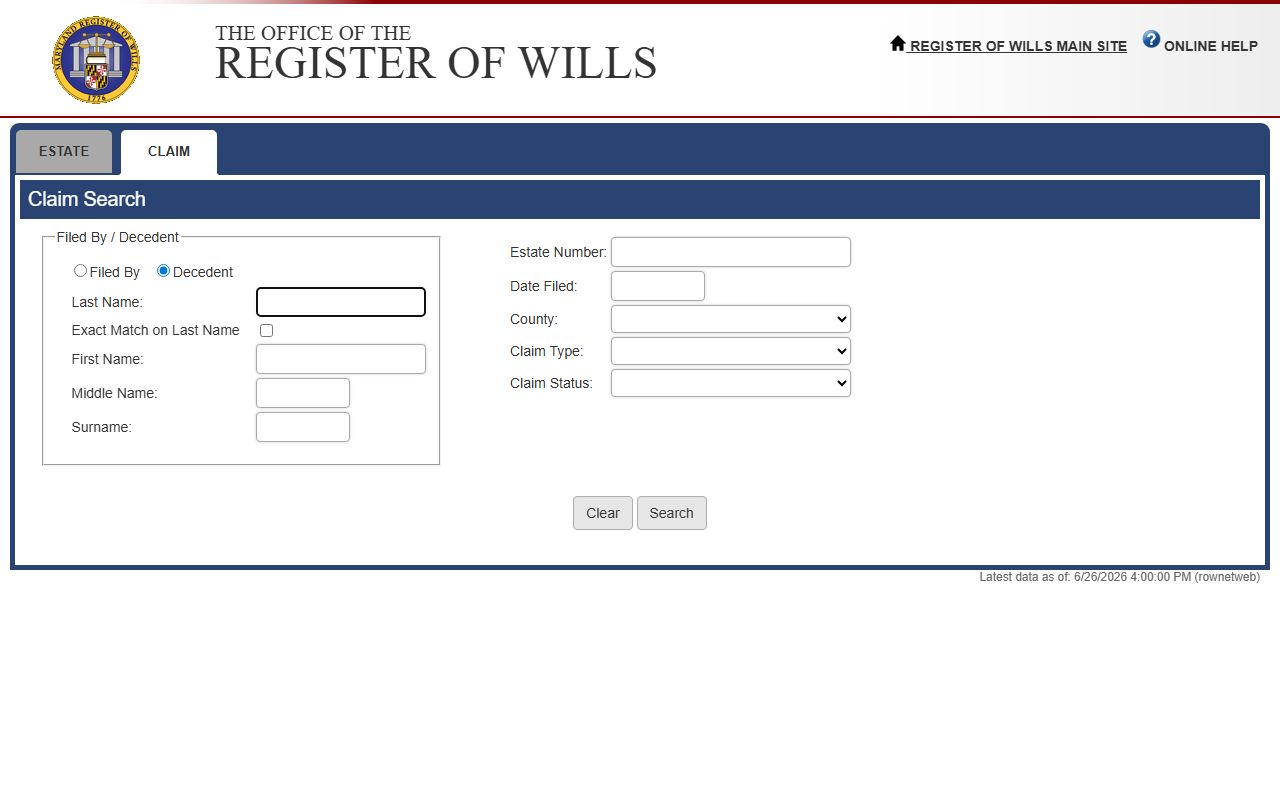
Claim searches should use Talbot County and the estate number when known, because surname-only searches can return people with the same name from other Maryland counties.
| Field Label | Type | Required | Options or Format Notes |
|---|---|---|---|
| Filed By or Decedent | Radio | Optional | Decedent is the default selection in the research capture. |
| Last, First, Middle, Surname | Text | Optional | Name fields help narrow claims. |
| Corporation Name | Text | Conditional | Used when a corporate claimant search is enabled. |
| Estate Number | Text | Optional | Best field when the estate file is known. |
| Date Filed | Date | Optional | Uses a datepicker. |
| County | Dropdown | Optional | Includes Talbot and all Maryland counties. |
| Claim Type | Dropdown | Optional | Debt, contingency, or secured debt. |
| Claim Status | Dropdown | Optional | Open, pending, satisfied, withdrawn, disallowed, and partial status options. |
Talbot County Probate Workflow
Probate administration starts with deciding whether an estate must be opened and whether Maryland's small-estate rules apply. The personal representative or petitioner then files the will, petition, death certificate, interested-person list, and required forms with the Register of Wills for Talbot County. If the filing is accepted, letters or appointment authority may issue, and the estate moves through notice, inventory, claims, accounting, distribution, and closing steps.
- Determine whether an estate must be opened and whether it qualifies as a small estate.
- File the will, petition, death certificate, interested-person list, and required forms with the Register of Wills.
- Receive letters or appointment authority if the Register or Orphans' Court requirements are met.
- Give notice to interested persons and creditors under Maryland probate rules.
- File inventory, information report, accounts, and other required estate documents.
- Search estate claims separately when creditor claims are part of the matter.
- Close the estate after administration, distribution, taxes, claims, and approvals are complete.
The Register of Wills forms page collects probate forms used in Maryland estate administration.
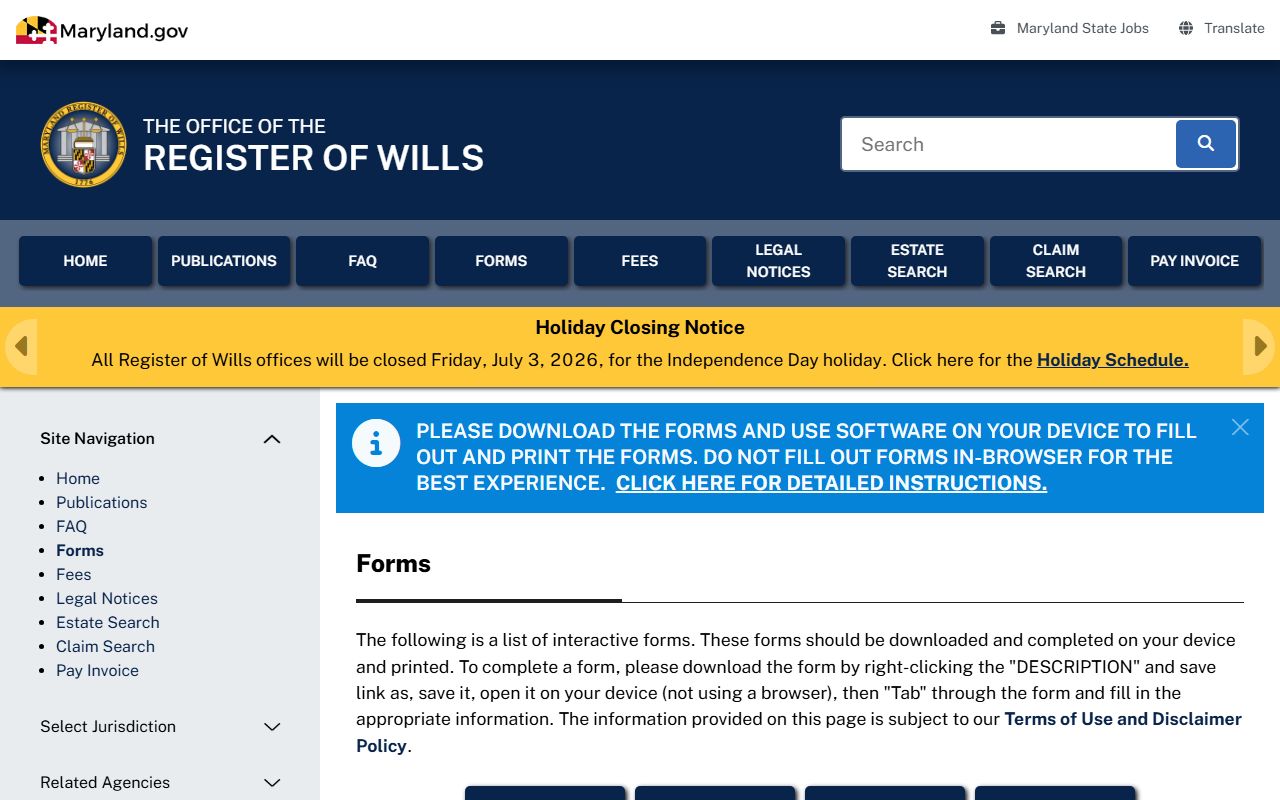
Forms should be matched to the estate type and filing stage, because a small estate, regular estate, claim, inventory, and account do not use the same filing package.
Talbot County Small Estate Records
Maryland small-estate treatment is controlled by state estates law, not by a county-made shortcut. The research file identifies Maryland Estates and Trusts section 5-601 as the relevant small-estate statute. A small estate can use a simplified process when it qualifies, but it still creates probate records that may be searched or requested through the Register of Wills.
The small-estate statute source is included here because it controls whether a Talbot County estate may use Maryland's small-estate framework.
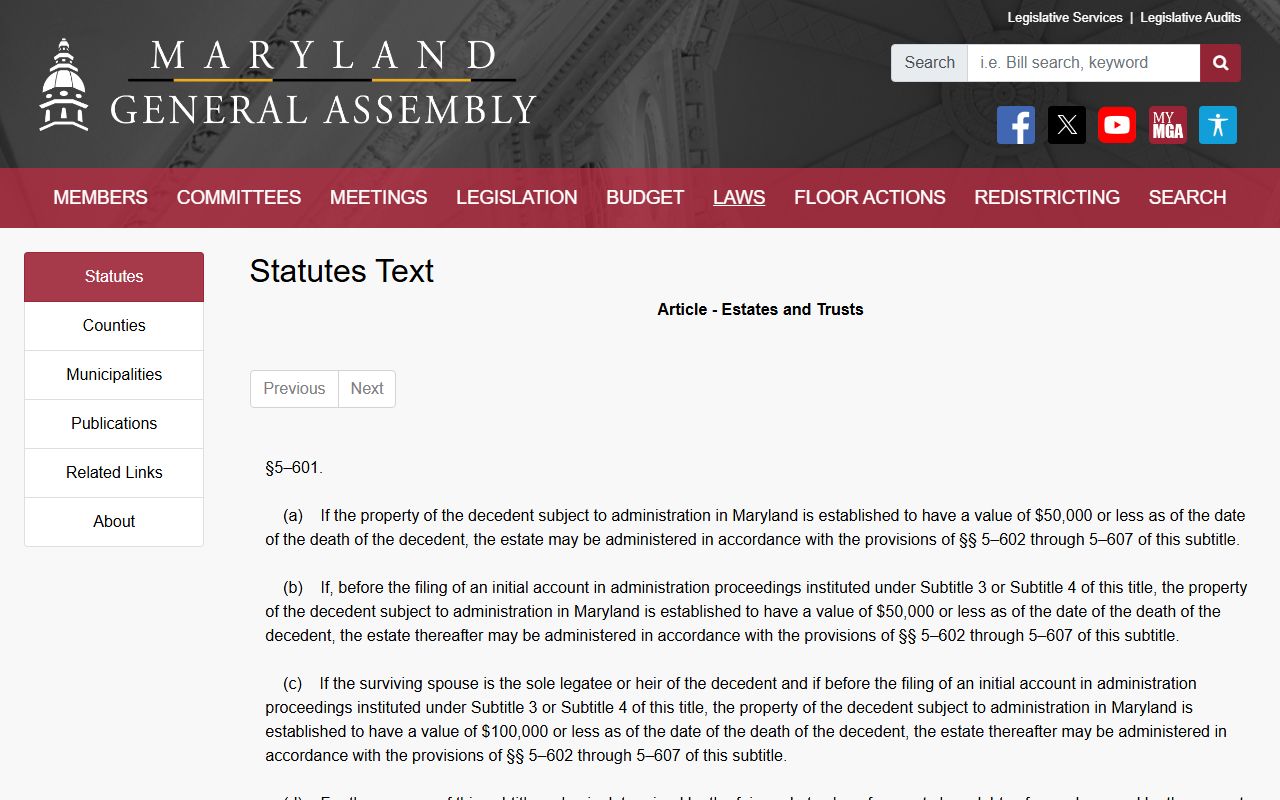
A user should not assume that a small estate has no record. Small-estate petitions, notices, letters, and closing documents can still matter for property, bank, vehicle, and family questions.
Talbot County Probate Fees
The research file does not provide exact Talbot probate fee amounts, so current fees should be checked through the Register of Wills and Maryland estate fee materials before filing. Estate filing fees can depend on estate size and filing type. Copy, certified copy, and claim-related charges may be separate from the initial estate opening cost.
| Item | Office | Amount Guidance |
|---|---|---|
| Estate opening or probate filing | Register of Wills | Use the current Register of Wills fee schedule. |
| Small-estate filing | Register of Wills | Depends on Maryland small-estate rules and current schedule. |
| Claim filing or claim copies | Register of Wills | Confirm based on claim type and copy request. |
| Certified estate copy | Register of Wills | Certification may add a separate charge. |
| Orphans' Court hearing filing | Orphans' Court or Register | Verify with the estate office before filing. |
The Register of Wills publications page provides estate guidance that can help filers understand probate duties before they pay filing or copy fees.
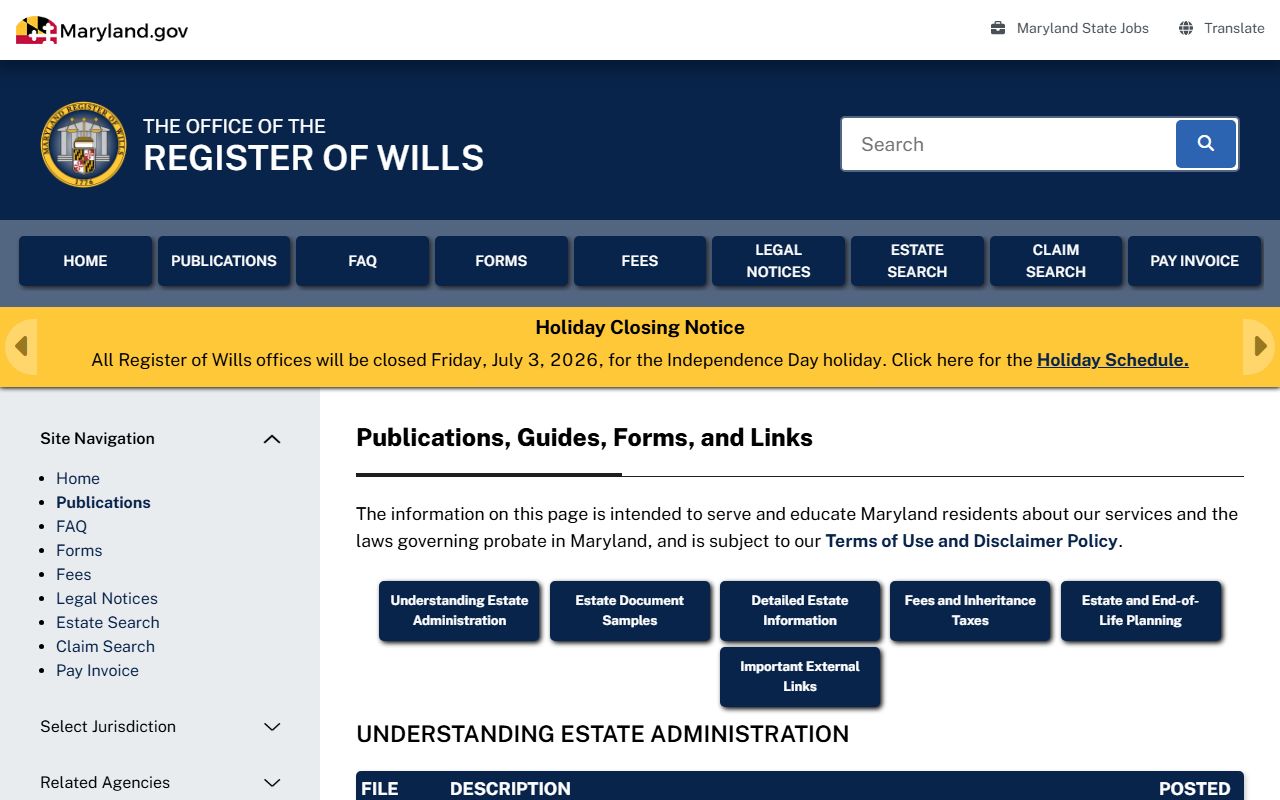
Publications are useful for process background, but fee and filing questions should still be checked against the current Talbot County Register of Wills office instructions.
What Talbot County Probate Records Show
Talbot County probate records may show the decedent's name, estate number, county, filing date, estate status, estate type, personal representative, interested persons, claims, inventories, accounts, and court actions. A public portal result is a search result or docket-style record, not always the full estate packet. Wills, inventories, and accounts may require copy requests, especially when a certified copy is needed for a bank, land record, tax matter, or court filing.
The Register of Wills search page is the central launch point for estate and claim searches in Maryland.
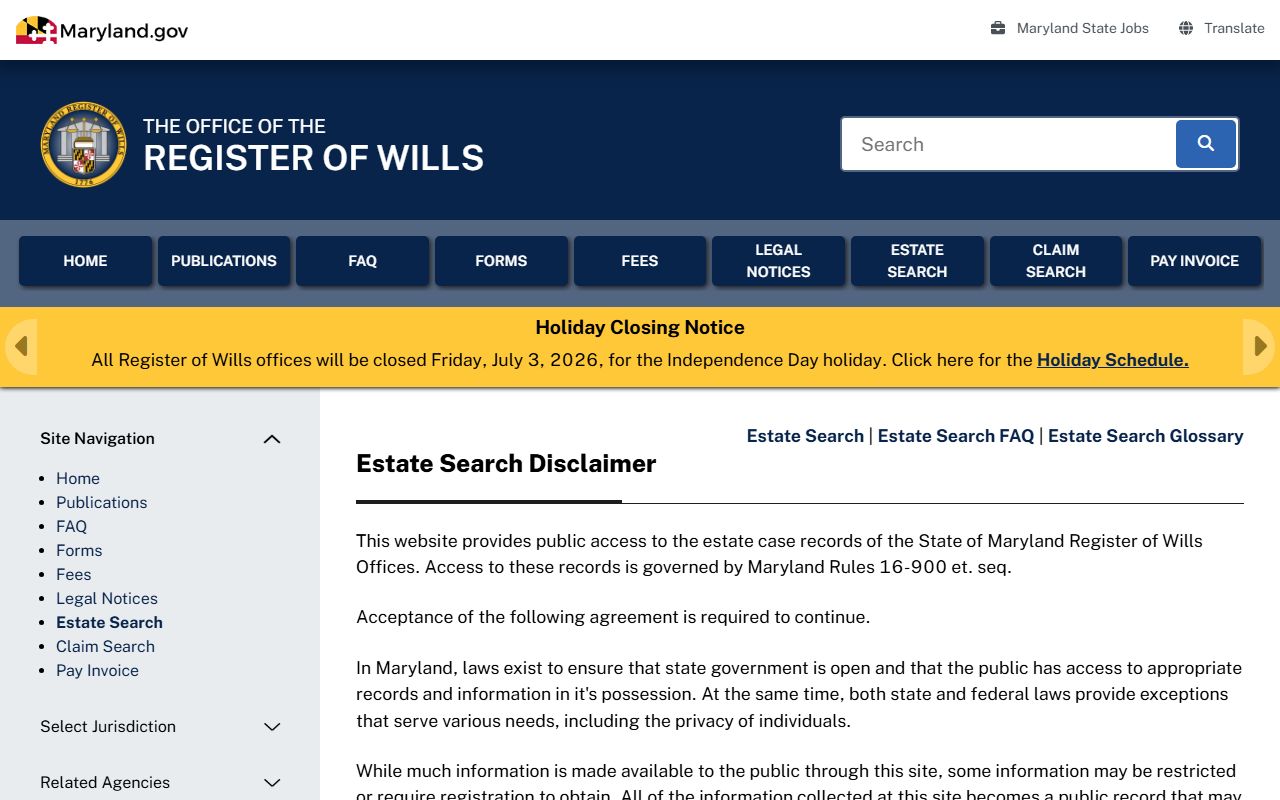
Search results should be cross-checked against party role, county, and filing date before a copy request is made, especially when common family names appear in more than one Maryland county.
Note: Estate Search and Claim Search are the preferred probate portals; county PIA is not the main route for probate court files.
Restricted Talbot County Probate Records
Most estate administration records are public to some degree, but probate access is not unlimited. Records involving minors, guardianship issues, medical information, protected addresses, sealed disputes, or private financial data may be restricted, redacted, or available only to parties and authorized users. Orphans' Court orders and Register of Wills records should be requested through the probate channel that holds the file.
Users who need a certified copy should ask for the exact document, not a broad answer about an estate. The county PIA page says county government does not have to answer informational questions or create records in response to a request. That same practical lesson applies here: probate staff can process records more effectively when the request names the estate, estate number if known, decedent, document type, and date range.