
Talbot County Arrest Records and Charges
Talbot County arrest records come from the law-enforcement and custody side of an event. They may involve an arresting agency, booking record, custody status, incident number, or jail roster entry. Once a charging document is filed, the court charge record begins. That court record identifies the charge, statute, court, case number, filing date, defendant, bond or initial appearance data when public, and later charge status.
The distinction matters because an arrest does not prove that a charge was filed, and a filed charge does not prove a conviction. Talbot County Corrections and the sheriff-related records process are used for current custody or law-enforcement records. Maryland Case Search and the court clerk are used for filed charges and court status. For the full case file with pleas, motions, dispositions, and sentencing, use Talbot County criminal court records.
Find Talbot County Arrest Records
Start with the record type. For current custody, use the official Talbot County Corrections JailTracker roster or call Corrections. For court charges after arrest, use Maryland Judiciary Case Search. For police reports, incident records, or booking records not posted online, use the Sheriff's Records Division or the Talbot County PIA process when the record is a county agency record rather than a court file.
- Check custody status first if the question is whether the person is currently in jail.
- Search Case Search by defendant name, case number, or citation number to find filed charges.
- Open the case and read each charge, statute, court, filing date, and current status.
- Compare the charge status with the later disposition before treating the charge as an outcome.
- Request agency records or certified court copies from the office that keeps the specific record.
The Talbot County inmate records path is the better place for jail roster and booking detail, while the court-charge path follows the arrest-to-court record.
Charges Filed After Arrest
Charges after arrest may begin with law enforcement paperwork, judicial officer review, prosecutor action, or grand jury action depending on the offense and court level. Maryland uses the State's Attorney title for the prosecutor. The Office of the State's Attorney for Talbot County decides prosecution strategy and may pursue, amend, reduce, dismiss, or resolve filed charges. The court docket tracks those decisions as public entries when the record is not restricted.
| Document | Who Files or Initiates It | How It Is Used |
|---|---|---|
| Complaint or statement of charges | Law enforcement, complainant process, or prosecutor path | Often starts District Court criminal matters and identifies the alleged offense. |
| Information | State's Attorney | Prosecutor-filed charging document used to pursue criminal charges in court. |
| Indictment | Grand jury | Charging document commonly used for serious felony matters in Circuit Court. |
The manifest image from the U.S. Attorney's Office for the District of Maryland marks the federal prosecutor path, which is separate from Talbot County State's Attorney charges.
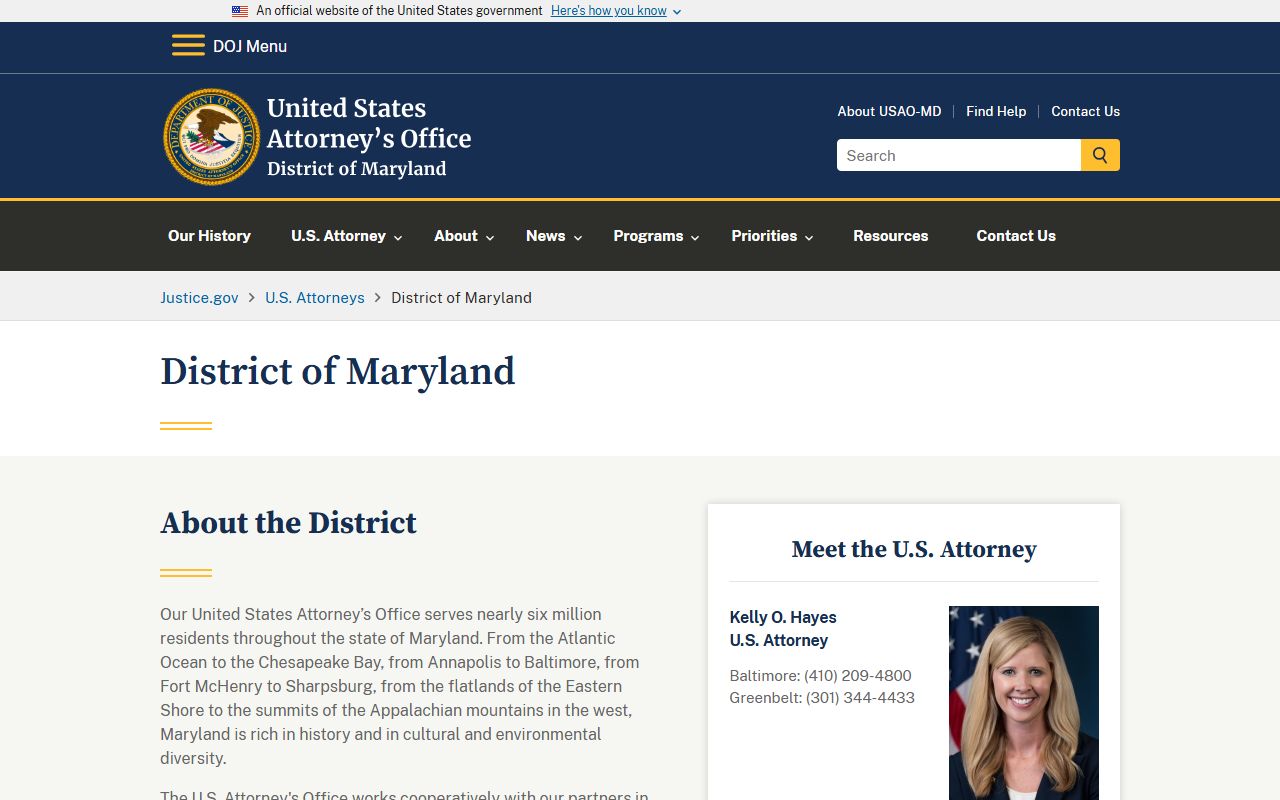
Federal charges are searched through federal court systems, while state and local Talbot County charges are searched through Maryland court records.
Talbot County Charge Status
Charge status can change many times before a case ends. One arrest can produce several charges, and each charge may have a different outcome. A prosecutor may amend a charge, reduce it, add a new count, dismiss it, enter nolle prosequi, place a matter on stet, or proceed to plea or trial. A reader should not stop at the first charge line. The final or current disposition controls what the court record means.
| Status | What It Means |
|---|---|
| Pending | The charge remains open and has not reached final disposition. |
| Amended / Reduced | The filed accusation changed, often in wording, severity, or count structure. |
| Dismissed | The court or prosecutor ended the charge without a conviction on that count. |
| Nolle Prosequi | The State chose not to prosecute that charge at that time. |
| Guilty / Not Guilty | The charge reached a plea or trial outcome. |
Charges vs Convictions
A charge is an accusation. A conviction is a court outcome. Talbot County arrest records and charge records may show charges that never became convictions. A background review, personal case check, or records request should read the disposition for each charge instead of assuming that arrest, charge, and conviction are the same event.
| Point | Charge | Conviction |
|---|---|---|
| Legal meaning | Filed accusation after arrest or charging event. | Guilty plea, guilty verdict, or qualifying conviction outcome. |
| Where it appears | Early in the court charge record. | In the disposition and sentencing portion of the criminal case. |
| May change | Can be amended, reduced, dismissed, or not prosecuted. | May lead to sentence, probation, fines, restitution, or later relief. |
| How to verify | Read charge status and docket events. | Read final disposition and sentence entries. |
Booking, Bond, and Warrants
Booking and custody information may be available from Talbot County Corrections, while court charges appear after the filing step. If an arrest occurred on a warrant, the court docket may show bench warrant, recall, quash, bond, or failure-to-appear events when public. Active warrants, sealed warrants, juvenile warrants, and investigative records may be restricted for safety or law-enforcement reasons.
The manifest image from the Federal Bureau of Prisons inmate locator is useful only when custody has moved into the federal prison system.
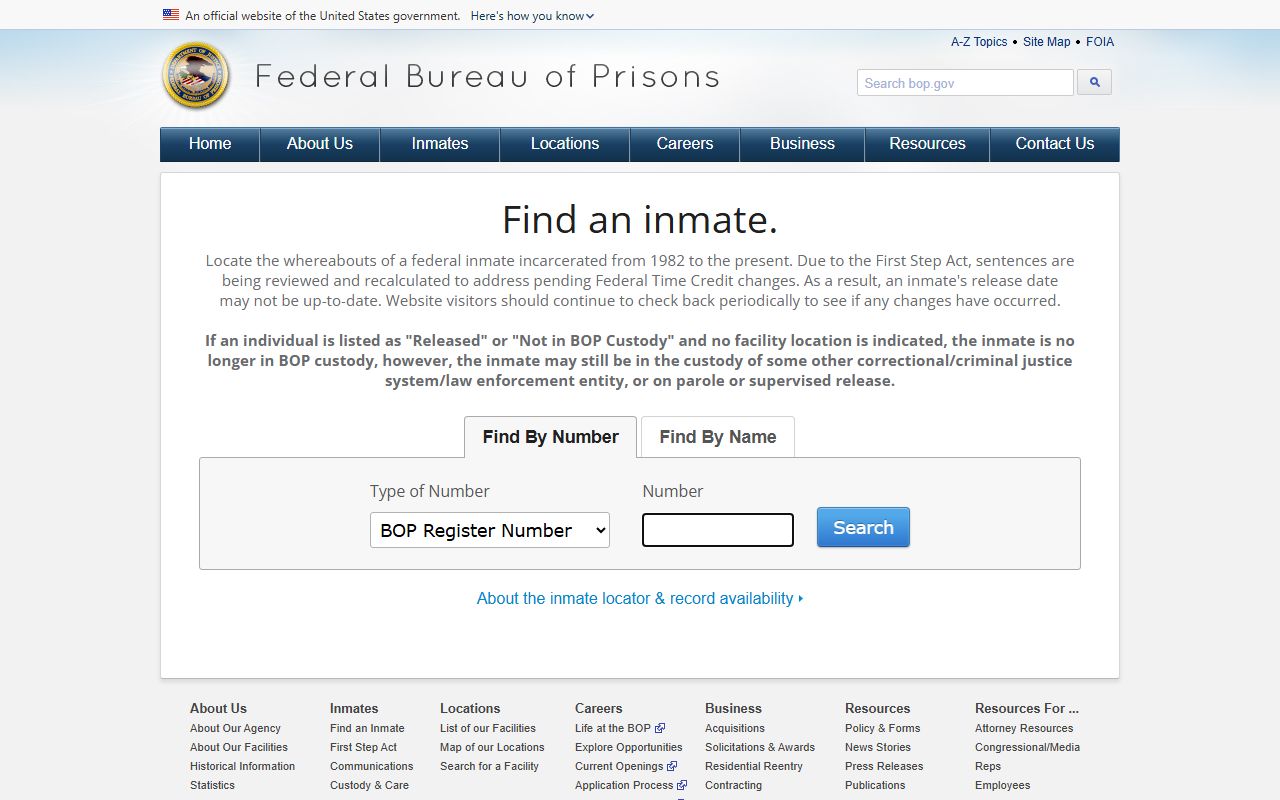
Federal prison custody is not the same as a Talbot County booking record, so state, county, and federal custody tools should not be mixed.
Sheriff Records and Court Records
The Talbot County Sheriff's Office is a county-wide law-enforcement agency with records, civil process, patrol, judicial protection, investigations, sex offender, domestic violence, and Most Wanted functions listed in official research. The sheriff or another law-enforcement agency may create reports, arrest records, or incident material. Those agency records are not the same as the court charge record. If the requested item is not a court file, the Talbot County PIA form asks for the department or agency with custody and a specific description of the record sought.
The county PIA process can be used for agency records, but it cannot force the county to answer open-ended questions or create a new record. A useful request names the person, incident, agency, date range, case or incident number if known, and type of record. Court copies still belong with the court clerk.
Note: A broad question such as "does this person have charges" is weaker than a request tied to a court case or agency record.
Restricted Arrest and Charge Records
Not all arrest records or charge records are public. Juvenile court records are restricted under Maryland Courts and Judicial Proceedings section 3-8A-27. Sealed cases, expunged records, shielded records, protected victim data, minor names, confidential informant material, search-warrant material before disclosure, and active investigative records may be unavailable or redacted. A missing public result does not prove that nothing happened.
The manifest image from the juvenile confidentiality statute source helps explain why some Talbot County arrest records and court charges do not appear in ordinary public lookup.
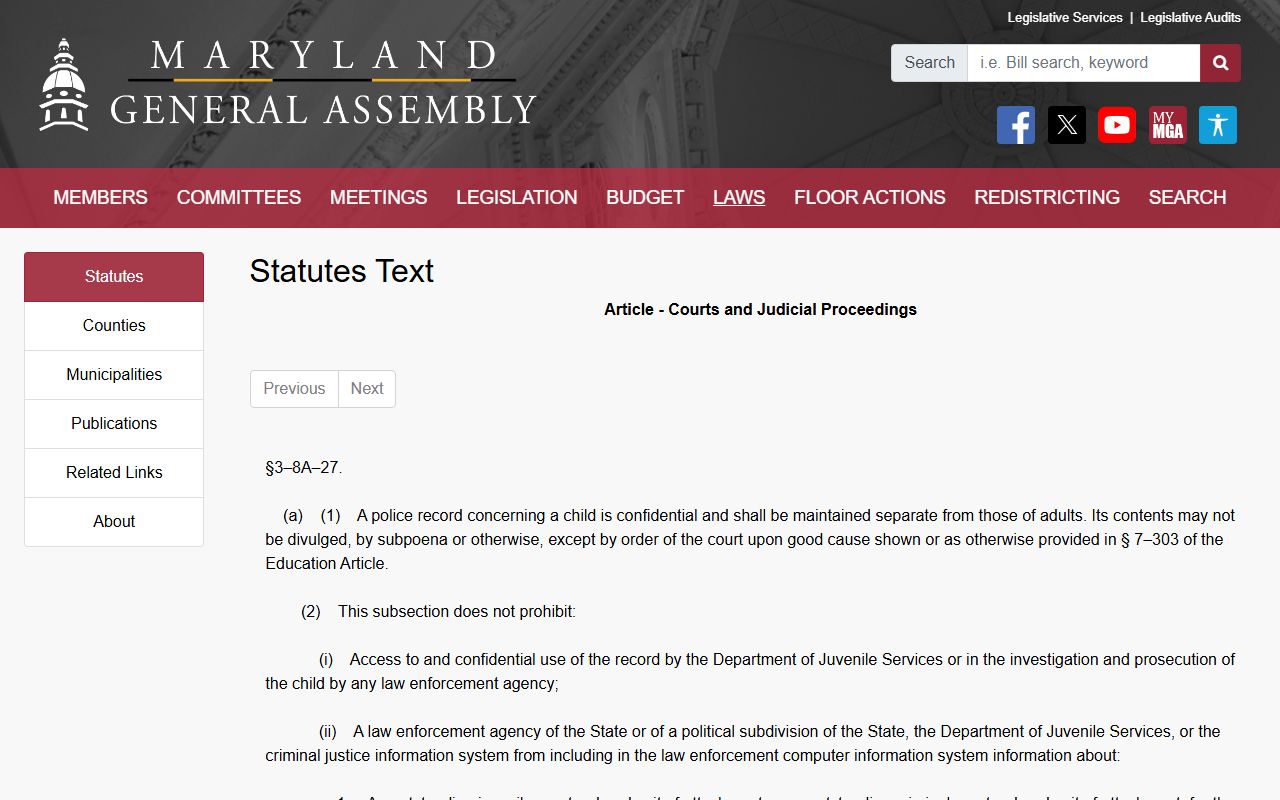
Juvenile confidentiality is a hard public-access boundary, so public search tools should not be expected to show those files.
| Point | Sealed | Expunged |
|---|---|---|
| Public view | Closed to ordinary inspection. | Removed from ordinary public access after processing. |
| Reason | Rule, statute, privacy, safety, or court order. | Qualifying outcome, waiting period, petition, and court order. |
| Where to start | Originating court clerk or court order process. | Maryland Judiciary expungement forms and the court that concluded the case. |
Charge Records and Background Checks
Talbot County arrest records, court charges, and criminal court records can be useful for personal review, court follow-up, or case tracking. They are not the same as a regulated employment, tenant, credit, insurance, or licensing background report. Some records may be incomplete, restricted, outdated, or changed by later court action. Any regulated screening decision should use a lawful, FCRA-compliant process and verify records with the originating government office.
For statewide criminal-history or legal-defense questions, use official Maryland channels. For federal charges, use federal court and federal custody tools. For local court charges after arrest, the best path remains Case Search plus the court or agency that created the record.
Important: Arrest is not a conviction, and each charge must be checked against its final court disposition.