
Talbot County Criminal Court Records
A criminal court record is the court-maintained case file, not the law-enforcement arrest report. In Talbot County, the record begins once a charging document, statement of charges, information, or indictment is filed and the case is opened in court. The record can then grow through arraignment, counsel appearances, bond entries, pretrial motions, hearings, plea negotiations, trial, verdict, disposition, sentence, restitution, fines, costs, probation entries, and later violation or post-conviction filings when public.
The District Court of Maryland for Talbot County handles many misdemeanors, preliminary matters, and certain felonies. The Circuit Court for Talbot County handles felony indictments, jury-trial cases, serious criminal matters, and appeals. When a case moves between court levels, the docket may show transfer or appeal events. A narrower look at Talbot County arrest records and charges is useful for charge wording and filing status, while this criminal court records page focuses on the full court case and outcome.
Search Talbot County Criminal Cases
Maryland Judiciary Case Search is the primary public lookup for Talbot County criminal court records that are not sealed, expunged, juvenile, or otherwise restricted. Search by defendant name or exact case number where possible. If a case began from a traffic citation or a statement of charges, a citation or tracking number may also help, but the public interface should not be treated as a full document download system.
- Open Case Search and choose the search mode that matches the available information.
- Enter the defendant name, case number, or citation number, then limit to Talbot County if that option is available.
- Compare the case type, court, filing date, defendant name, and status before opening a result.
- Read the charge list, docket events, plea, disposition, sentence, and bond entries where public.
- Request certified copies from the Clerk of the Circuit Court or District Court clerk when legal proof is needed.
For defense access, eligibility, and appointed-counsel questions, use the Maryland Office of the Public Defender. The clerk keeps court records, but the clerk does not provide legal advice or act as defense counsel.
Talbot County Criminal Case Flow
A criminal docket should be read as a time line. Charges come first, but they are only accusations. The case record then shows how the court handled the accusation. A plea, trial result, dismissal, nolle prosequi, acquittal, or guilty finding can change the meaning of the original charge entry. Sentencing entries may include jail time, suspended time, probation, restitution, fines, costs, treatment, or other conditions when public.
Case flow: Charges Filed › Arraignment › Pretrial / Motions › Plea or Trial › Disposition › Sentencing
| Stage | What Happens |
|---|---|
| Charges Filed | The accusation is filed in District Court or Circuit Court through a charging document, information, or indictment. |
| Arraignment | The defendant is advised of charges and enters or addresses a plea according to the court process. |
| Pretrial / Motions | Attorneys may file motions, discovery issues may arise, and hearings may be scheduled. |
| Plea or Trial | The case resolves by plea, bench trial, jury trial, dismissal, nolle prosequi, or other disposition. |
| Sentencing | The court imposes sentence, probation, fines, costs, restitution, or other public conditions if there is a conviction or qualifying plea. |
What Talbot Criminal Records Show
Talbot County criminal court records can show more than a single charge. The docket may include the charge description, statute, court, filing date, case number, defendant, attorney, judicial officer, hearing schedule, bond status, plea, disposition, sentence, financial obligations, and public probation or violation events. Some data is redacted, and some documents are not public at all.
| Field | What It Shows |
|---|---|
| Case Number | The court identifier used to search, verify, and request copies. |
| Defendant | The person charged in the criminal case, subject to redaction rules. |
| Charges | The filed accusation, statute, severity, and sometimes tracking or citation data. |
| Bond / Release | Public release conditions, bond amount, or warrant-related events when shown. |
| Plea | The defendant's formal answer, such as guilty, not guilty, or other plea event. |
| Disposition | The outcome for the case or each charge, such as guilty, not guilty, dismissed, or nolle prosequi. |
| Sentence | Jail, suspended time, probation, restitution, fines, costs, or conditions when public. |
Charges and Convictions
A charge is not proof of guilt. It is the formal accusation that starts or supports the criminal case. A conviction is the outcome after a guilty plea, guilty verdict, or other conviction event recognized by the court. A Talbot County criminal record can show charges that were reduced, amended, dismissed, placed on stet, ended in nolle prosequi, or resulted in acquittal. Read each charge line with its own disposition.
| Point | Charge | Conviction |
|---|---|---|
| Meaning | An accusation filed with the court. | A final or current guilty outcome for a charge. |
| Timing | Appears early in the case. | Appears after plea, verdict, or qualifying court outcome. |
| Public effect | May remain visible unless restricted, shielded, or expunged. | May affect sentencing, supervision, and background records. |
| Best check | Read charge status and later amendments. | Read disposition and sentence entries. |
State's Attorney and Defense
Maryland uses the title State's Attorney, not District Attorney. The Office of the State's Attorney for Talbot County is the prosecuting authority for criminal cases after law enforcement files or refers charges. The State's Attorney may pursue, amend, reduce, dismiss, or resolve charges through plea or trial. That work appears in the court record through charge status, motions, plea entries, docket events, and dispositions.
The manifest image from the Maryland Office of the Public Defender identifies the official defense agency for eligible indigent defendants in Talbot County criminal cases.

Public defender access is separate from public record access; the criminal court record shows what was filed, while counsel handles defense strategy and eligibility questions.
Sealed and Expunged Records
Sealing, shielding, and expungement are different. A sealed file is closed to ordinary public inspection by court rule or order. A shielded record is hidden from general public access under Maryland law for certain qualifying convictions, though courts and law-enforcement access can remain. An expunged record is removed from public access under the court order and applicable law, but the legal effect can vary by agency and context.
| Point | Sealed | Expunged |
|---|---|---|
| Visibility | Closed to ordinary public inspection. | Removed from ordinary public criminal record access. |
| How it happens | By rule, statute, or court order. | By petition and order when the record qualifies. |
| Examples | Juvenile, protected, or court-sealed matters. | Qualifying acquittals, dismissals, nolle prosequi, stet outcomes, or certain convictions. |
| Practical effect | May still exist for authorized users. | Should not appear in ordinary public criminal court searches after processing. |
The manifest image from Maryland Criminal Procedure section 10-105 supports the expungement rules used for qualifying criminal records.
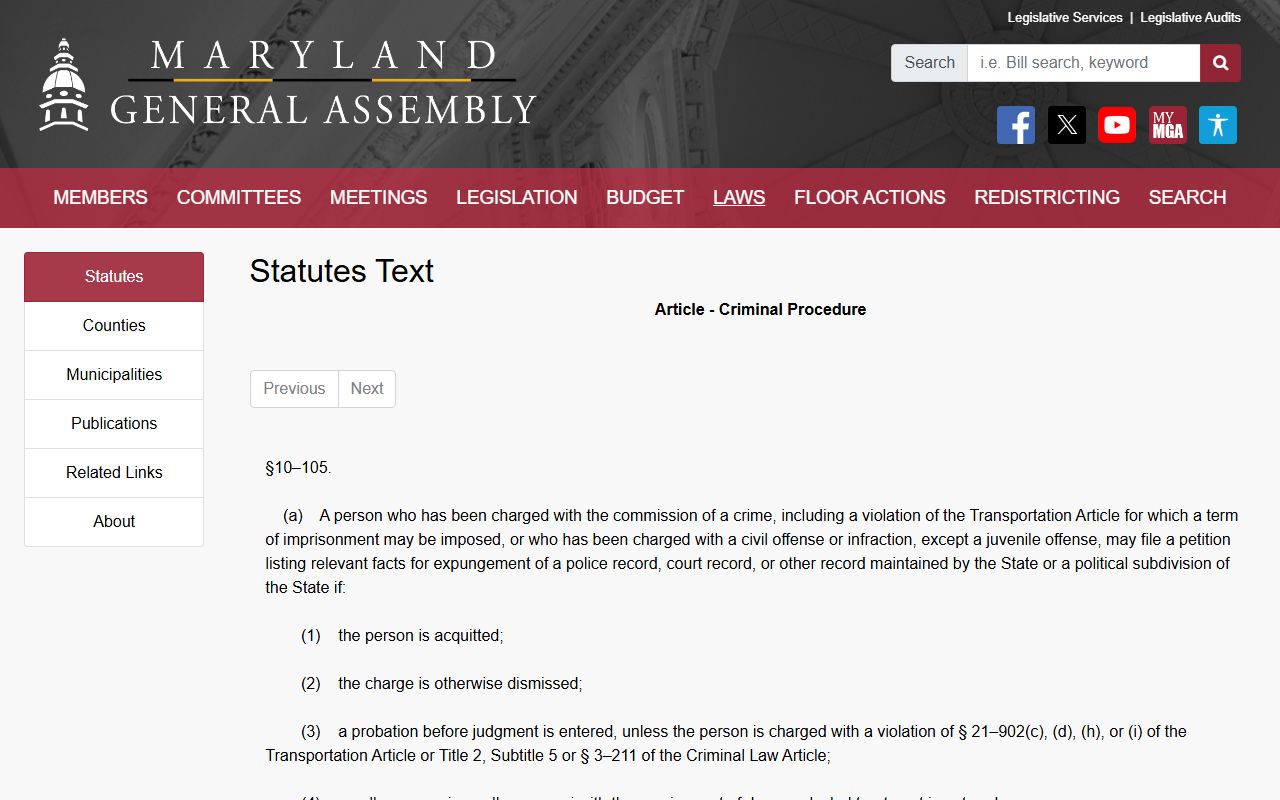
That statute is the starting point for many Maryland expungement questions, but eligibility depends on the charge, outcome, waiting period, and case history.
The manifest image from Maryland Criminal Procedure section 10-110 shows the separate shielding framework.
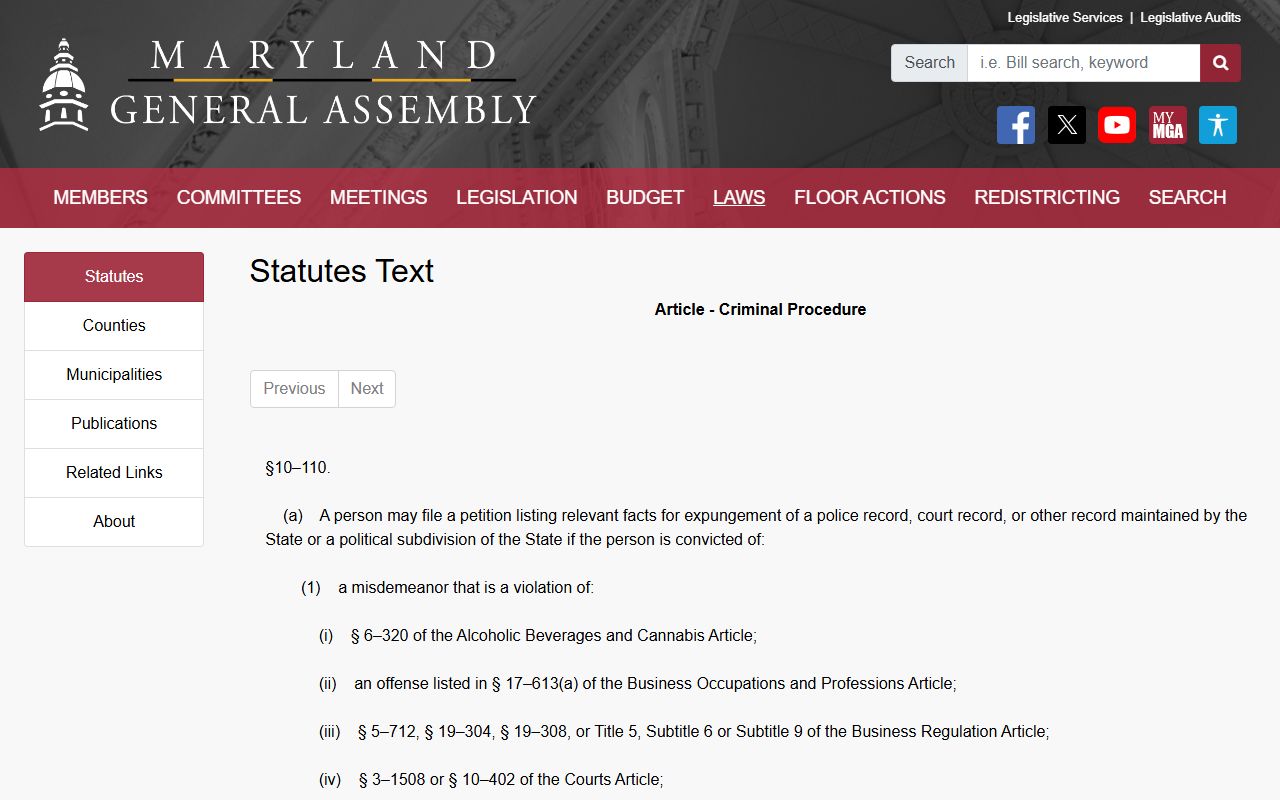
Shielding can limit public access to certain conviction records without making the case the same as an expunged matter.
Public Access to Criminal Records
Public criminal court records in Talbot County are governed by Maryland judicial-record rules. Maryland Case Search is a public lookup path, but it does not override sealed, expunged, juvenile, adoption, protected-personal-identifier, or other access limits. The Maryland Judiciary expungement help page and official court forms are the correct starting points for record-clearing procedures.
For copies, use the court that owns the record. Circuit Court copies route to the Clerk of the Circuit Court at the Talbot County Courthouse. District Court criminal and traffic-related criminal records route to the District Court clerk in Easton. Current custody belongs with Talbot County Corrections and the jail roster, not the criminal court file. Active warrant questions may require the issuing court, counsel, or law enforcement because some warrant data is not public.
Important: Criminal court lookup is not a substitute for an FCRA-compliant background check for regulated screening decisions.